Marketing From the Aisles
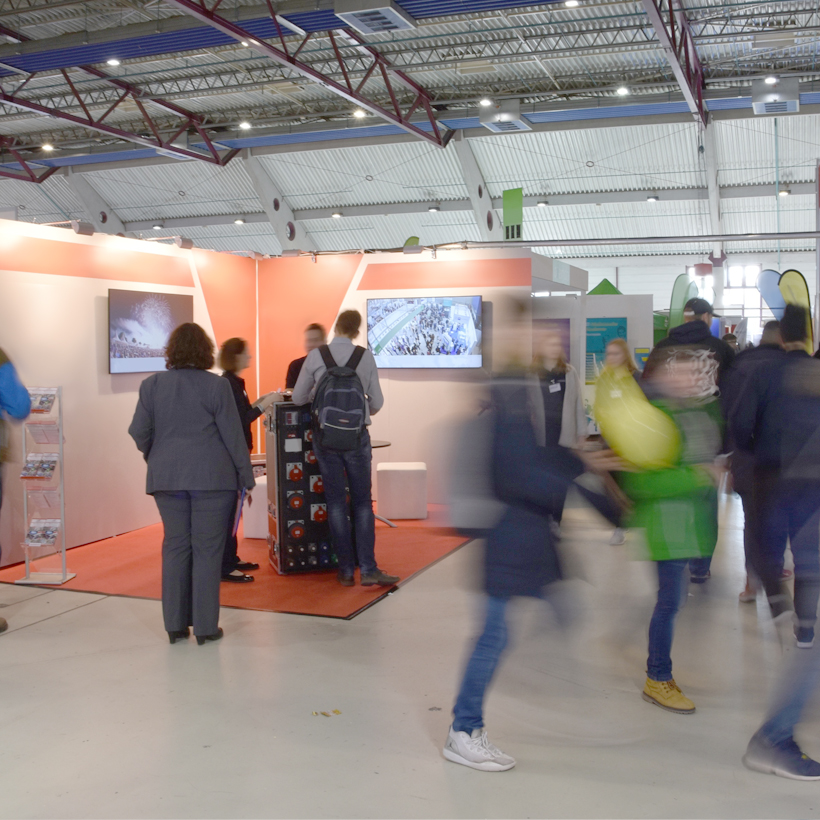
Trade shows have always fascinated me, especially niche or industry specific conferences where companies invest in booths as a way to stay visible within their own market. I attend many of these events alongside clients, and a familiar pattern often emerges. Booth after booth is staffed by teams speaking primarily to industry peers. Sales teams talking to competitor sales teams. Competing brand marketing teams exchanging impressions of jobs well done. Leadership walking the floor to observe how competitors are positioning themselves.
Every time, I find myself asking the same question. Why spend over fifteen thousand dollars to market your business in a room filled mostly with companies that already understand your space as well as you do? The most common answer usually centers on appearances. Staying visible. Reinforcing presence. Avoiding the perception that something has changed. Maybe a platinum sponsor is peacocking for the few potential customers that made an appearance in an attempt to stand out from the pack. While I understand that reasoning, it never fully clicked for me. There are often far more cost effective ways to signal stability and relevance. For someone who tends to think a bit differently about marketing, trade shows eventually became less about criticism and more about opportunity, specifically an opportunity to rethink how visibility really works.
about

We’re a high-quality, all-inclusive graphic design subscription for brands and businesses.
When everyone is selling in the same room, visibility increases, but meaningful differentiation becomes much harder to achieve.
The Trade Show Appearance Trap
Marketing Performing For Itself
Industry trade show spaces are for reassurance. Companies convince themselves that showing up is more important than standing out. The problem is that when everyone is there for the same reason, nobody wins meaningful attention. You are not surrounded by buyers. You are surrounded by peers doing the exact same thing, often with larger budgets and louder displays. In these environments, the most successful booths are rarely the ones selling the core product. They are the distributors, manufacturers, service providers, and support companies that serve the entire industry.
They have positioned themselves one step removed from the competition. Their customers are everywhere around them, often trapped at neighboring booths for days at a time. With minimal competition for attention, they get hours of uninterrupted face time with exactly the people they want to meet. Watching those booths operate made something click. They were marketing smarter, not harder. The cost-to-benefit ratio is substantially higher.
Flip the floor map upside down
Marketing Where Customers Gather
That realization changed how I approached trade shows entirely. I used to look where my competition might exhibit and hope to show the superiority of my services. Instead, I began asking, “Which trade shows are filled with companies that would benefit from my services?” OSHA, OTC, Valve World. These events are packed with businesses that rely heavily on marketing, branding, catalogs, presentations, and trade show materials. Many of them struggle with marketing consistency or quality execution. Perfect.
Trade shows offer unexpected opportunities when approached as a participant rather than a traditional exhibitor.
I stopped buying booths altogether. I attended as a participant with a simple strategy. Walk the floor. Start conversations. Ask people about their business. People love talking about what they do when the interest is genuine. Eventually, the question comes back to me. That is when I explain Predi Designs honestly. I am there to learn, to collect inspiration, and to sell when it makes sense. I carry business cards and I carry curiosity. I also leave with shelves full of beautifully designed catalogs that still inspire my work today.
Not every conversation lands. Some salespeople lose interest the moment they realize I am not a buyer. That does not matter. Twenty failed conversations are irrelevant if one good relationship comes from it. The cost is minimal. The upside is real.
Meaningful business relationships often begin with listening, not pitching, especially in busy trade show environments. You can better gauge where your value is needed this way.
One Conversation Made It Worthwhile
Alright Stop. Collaborate and Listen.
One of my favorite examples came from an OSHA trade show. After hours of talking, I was exhausted and approached a booth that looked like it has been re-utilized for several years. Old banners, outdated brochures, nothing visually impressive. I had no intention of pitching. I just needed a break.
Two people at the booth were deep in conversation, deep in a debate about recent regulatory changes to the industry. I listened. I stayed quiet. I was genuinely interested. Ten minutes passed before they even acknowledged me. When they finally did, I was already part of the conversation. I offered an outsider’s perspective. No pitch. No agenda. Just a real discussion. Before leaving, I handed them my card.
A month later, they became a client. We still work together today.
That entire trade show cost me next to nothing. No booth fee. No shipping. No setup. Just time, awareness, and the willingness to talk to people without forcing a sale. If you want a deeper look at how experiential marketing continues to evolve beyond booths, Event Marketer has covered this shift well.
You do not need a booth to sell at a trade show. You need to be intentional about where you stand and who you talk to.
When everyone is selling in the same room, visibility increases, but meaningful differentiation becomes much harder to achieve.
The Trade Show Appearance Trap
Marketing Performing For Itself
Industry trade show spaces are for reassurance. Companies convince themselves that showing up is more important than standing out. The problem is that when everyone is there for the same reason, nobody wins meaningful attention. You are not surrounded by buyers. You are surrounded by peers doing the exact same thing, often with larger budgets and louder displays. In these environments, the most successful booths are rarely the ones selling the core product. They are the distributors, manufacturers, service providers, and support companies that serve the entire industry.
They have positioned themselves one step removed from the competition. Their customers are everywhere around them, often trapped at neighboring booths for days at a time. With minimal competition for attention, they get hours of uninterrupted face time with exactly the people they want to meet. Watching those booths operate made something click. They were marketing smarter, not harder. The cost-to-benefit ratio is substantially higher.
Trade shows offer unexpected opportunities when approached as a participant rather than a traditional exhibitor.
Flip the floor map upside down
Marketing Where Customers Gather
That realization changed how I approached trade shows entirely. I used to look where my competition might exhibit and hope to show the superiority of my services. Instead, I began asking, “Which trade shows are filled with companies that would benefit from my services?” OSHA, OTC, Valve World. These events are packed with businesses that rely heavily on marketing, branding, catalogs, presentations, and trade show materials. Many of them struggle with marketing consistency or quality execution. Perfect.
I stopped buying booths altogether. I attended as a participant with a simple strategy. Walk the floor. Start conversations. Ask people about their business. People love talking about what they do when the interest is genuine. Eventually, the question comes back to me. That is when I explain Predi Designs honestly. I am there to learn, to collect inspiration, and to sell when it makes sense. I carry business cards and I carry curiosity. I also leave with shelves full of beautifully designed catalogs that still inspire my work today.
Not every conversation lands. Some salespeople lose interest the moment they realize I am not a buyer. That does not matter. Twenty failed conversations are irrelevant if one good relationship comes from it. The cost is minimal. The upside is real.
Meaningful business relationships often begin with listening, not pitching, especially in busy trade show environments. You can better gauge where your value is needed this way.
One Conversation Made It Worthwhile
Alright Stop. Collaborate and Listen.
One of my favorite examples came from an OSHA trade show. After hours of talking, I was exhausted and approached a booth that looked like it has been re-utilized for several years. Old banners, outdated brochures, nothing visually impressive. I had no intention of pitching. I just needed a break.
Two people at the booth were deep in conversation, deep in a debate about recent regulatory changes to the industry. I listened. I stayed quiet. I was genuinely interested. Ten minutes passed before they even acknowledged me. When they finally did, I was already part of the conversation. I offered an outsider’s perspective. No pitch. No agenda. Just a real discussion. Before leaving, I handed them my card.
A month later, they became a client. We still work together today.
That entire trade show cost me next to nothing. No booth fee. No shipping. No setup. Just time, awareness, and the willingness to talk to people without forcing a sale. If you want a deeper look at how experiential marketing continues to evolve beyond booths, Event Marketer has covered this shift well.
You do not need a booth to sell at a trade show. You need to be intentional about where you stand and who you talk to.

Matthew A.
Owner of Predi Designs
Matthew began as an online content creator in his teenage years, crafting Flash animations and games for internet audiences and collaborating with other young creatives worldwide. He later graduated cum laude from Texas A&M University’s Visualization Program, where he honed his skills in design, animation, and interactive media. He has owned and operated Predi Designs since 2016.
A Subscription Just Makes Sense.
Predi Designs delivers unlimited high-quality graphic design for a flat monthly rate, making top-tier branding and marketing more affordable, flexible, and efficient than traditional agencies. Plus, without salaries, benefits, or equipment costs, it’s more cost-effective than hiring in-house. No hourly fees, no scope limits. Just fast, reliable design on demand. Scale smarter, save more, and streamline creativity with Predi Designs.
blog tags
related posts
 When people talk about branding, they usually point to the most visible piece. The ad, the logo, the booth, the hero graphic. That is the part everyone sees first, so it gets most of the credit. What matters more is what happens beyond those visuals. The structure that keeps everything consistent across dozens of touchpoints, over time, without falling apart. The companies that get this right are not relying on one standout moment. They are building something repeatable. Something that works whether you are looking at a website, opening a shrink-wrapped box, or walking past a booth. That level of consistency rarely comes from one person or one team working in isolation. It is usually a couple of marketing teams with their external partners working together toward the same system. That collaboration is what allows the brand to scale without losing itself.
 AutoPay is basically our “keep it boring” button for billing. Your flat monthly rate drafts on the same day every month, you still get an invoice for your records, and nobody has to send the awkward overdue invoice emails. It keeps projects moving, keeps the relationship strong, and keeps your brain on design rather than due dates. Security is handled seriously, mistakes get fixed fast with a 100% guarantee, cancellation is simple, and we even apply a convenience discount as a small thanks for making the whole thing run smoothly.
 Predi Designs has always grown through quality work and the kind of word-of-mouth that only comes from happy clients who value collaboration. The new website is built to showcase that trust. It gathers a deep portfolio of projects and highlights client testimonials so visitors can see not only what we create but also how we work with the people behind each brand. This site is proof of the relationships and results that built the business and the standard we continue to uphold.