AI: The Next Generation
Artificial intelligence is one of those technologies I cannot afford to ignore as a business owner. Tools like ChatGPT and Claude have already changed how people write, brainstorm, organize information, and generate visuals. ChatGPT launched publicly in November 2022, and the creative industry has been adjusting ever since.
That creates an obvious question for Predi Designs. Should we use AI?
As a business owner, I have to consider all the factors around any new technology that could make or break my business. Artificial intelligence tools have serious potential to be the Netflix to my Blockbuster. The honest answer is yes we should be using AI, carefully. Ignoring the tool completely would be a stubborn decision. Relying on it too heavily would be irresponsible. It is important to consider how to incorporate these tools in a clear-cut way that prevents the business from losing its edge, without compromising the soul of what we are trying to build at Predi Designs. The goal is to understand where AI helps, where it creates problems, and where a human designer still needs to make the final call.
AI has the potential to speed up parts of the creative process, but speed is not the same thing as quality. Our clients are not paying us to type prompts into a text field and hand over whatever comes out. They are paying for judgement, experience, taste, technical ability, and brand awareness. Those things still matter, especially when the final result is going to represent a real business.
about
We’re a high-quality, all-inclusive graphic design subscription for brands and businesses.
Predi Designs uses AI responsibly, like transcribing data from screenshots or scrubbing documents of irregular formatting issues. That kind of tedium would otherwise waste hours of potential design time.
We Walk The Line
Where AI Fits Into Our Workflow
AI is most useful when it takes tedious work off the table. There are plenty of tasks in design that are necessary but not especially creative. Cleaning up messy text, extracting information, organizing rough notes, turning scattered thoughts into something usable. Those are places where AI can save real time without taking over the actual design decision-making.
A good example is data extraction. Several Predi clients work in engineering-related industries, which means a lot of technical documents, specification sheets, and data tables. Sometimes that information exists only inside a PDF or screenshot, and there is no clean way to pull it into a spreadsheet. In the past, that could mean hours of manual typing, checking, and rechecking. Now we can use AI to help convert that table into structured data, then bring it into InDesign where the real design work happens.
Another example is document cleanup. We worked through a large batch of HSE policy documents that needed to follow the same formatting approach. AI was not capable of formatting the final documents correctly by itself. Not even close. What it could do well was strip away the messy parts: inconsistent bullets, strange spacing, random capitalization, odd tabs, and leftover formatting junk. That gave us cleaner text to work with and saved hours of mind-numbing cleanup.
That is where AI makes the most sense to me. It helps remove the parts of the process that slow humans down before the real work begins. It can help get past a blank page. It can help organize rough content. It can make tedious conversion tasks less painful. Used that way, AI creates more room for design instead of pretending to be the designer.
A Step Too Far
Where We've Reached an Impasse
Predi Designs does not treat AI-generated visuals as finished design work. At no point should one of our designers respond to a client request by simply generating an image with AI and sending it back as the final deliverable. That is not the service clients are paying for. A prompt result is not the same as a carefully built piece of marketing.
That does not mean we refuse to touch AI-generated material. Clients are using these tools, and that has changed what shows up in our inbox. Sometimes a client sends an AI image and asks us to fix the weird parts. Sometimes they ask us to make “something like this.” That can be useful as a rough directional reference, but it is rarely something we can treat as a final asset.
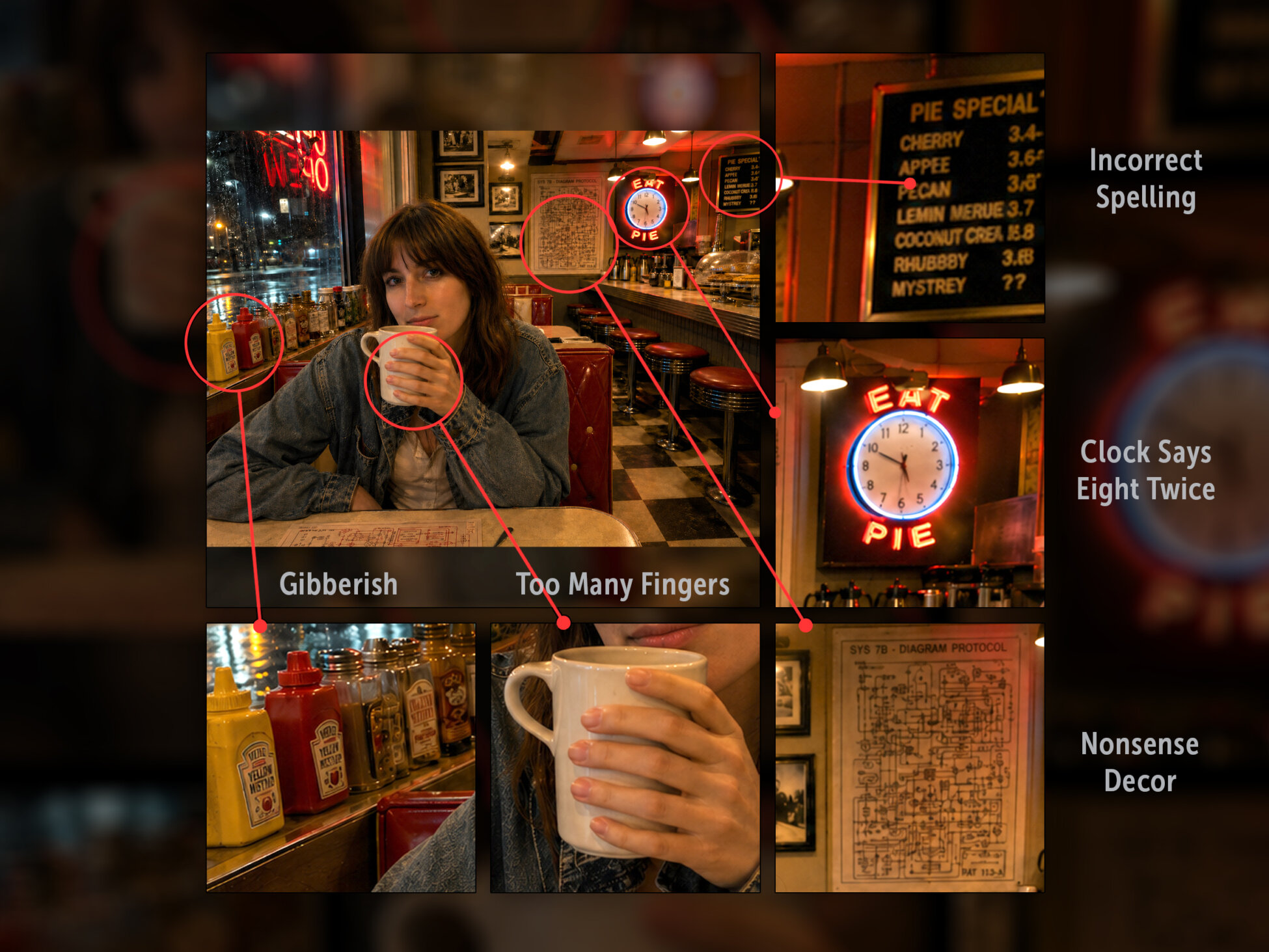
AI can create something that looks polished at first glance, but it often falls apart when inspected. Strange fingers, warped lettering, random artifacts, impossible product details, inconsistent lighting, and visual choices that make no practical sense. These types of errors can’t be fixed using AI once they are generated.
An AI generated image can look fine at first glance, but extremely often these images are filled with errors and artifacts that can't be fixed using the same tool that originally made them.
The client may be proud of what they generated, and therefore they ignore its obvious faults. Several have never had the capacity to “create” this effectively before. But speed does not magically turn the result into a professional marketing asset.
When a client sends us AI-generated material, we evaluate it like anything else. Is the idea useful? Is the visual direction worth keeping? Can the mistakes be corrected cleanly? Or would it be smarter to rebuild the concept properly from the ground up? AI has the potential to provide a starting point, but the final needs human judgment, human correction, and human responsibility.
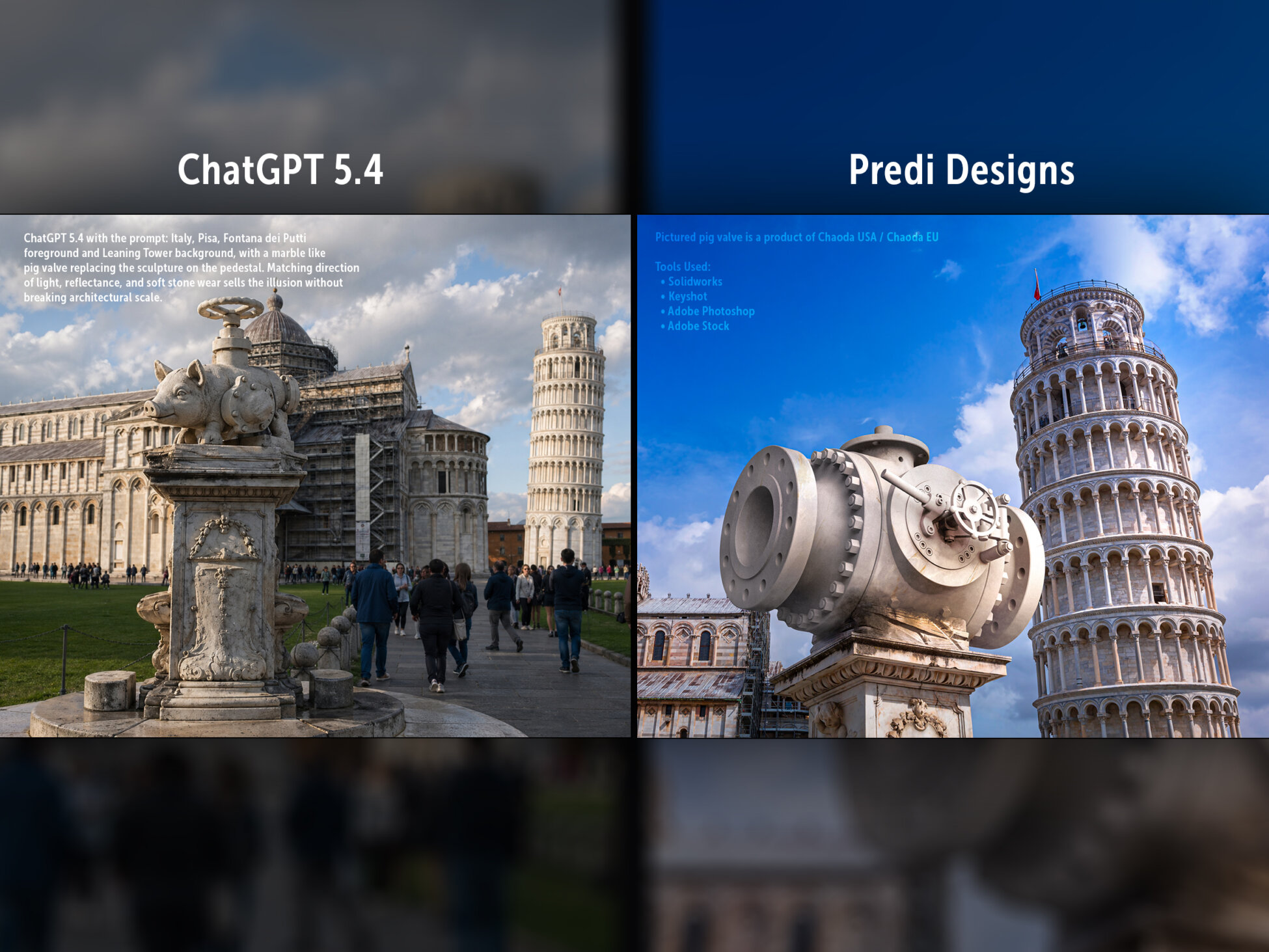
We did several tests to compare Predi's carefully crafted designs with ChatGPT's approach. This one in particular felt most pertinent. Instead of a pig valve, it created a valve in the shape of a pig.
AI Visuals Can Hurt A Brand
The Dangers For Our Clients
The biggest risk with AI visuals is not that they necessarily look bad. It is that they can look impressive to people who do not know what they are looking at, while looking completely wrong to the people who do. A general viewer may see a polished generated image and assume it is professional. Someone with industry experience may see the same image and immediately recognize that the details are incorrect and absurd. For Predi’s clients, especially in industrial, manufacturing, energy, and technical fields, that post can destroy a brand’s credibility.
I have seen AI-generated valve cutaways on LinkedIn that were absolutely ridiculous if you understand those products like I do. For the midstream company who posted the picture, that is not a small problem. The internal structure was complete nonsense, so it made the company look far less knowledgeable about the industry and that damaged their brand with the exact people the post was supposed to reach.
There is also a broader audience problem. AI-generated imagery still carries a stigma with a lot of people. The reaction depends on the industry, the use case, and how transparent the company is being, but backlash is real. A 2025 Clutch article reported that many consumers want brands to disclose AI use, and public controversies around AI art have shown that people do notice when companies appear to replace human creative work without care.
The gaming world has been a useful warning sign. In 2025, Game of the Year winner Clair Obscur: Expedition 33 became part of a public controversy after The Indie Game Awards rescinded awards over generative AI assets that violated its eligibility rules, even though the broader context around the game and its development was more complicated. The lesson for marketing is not “never touch AI.” The lesson is simpler: if your audience cares about craft, accuracy, or trust, AI usage can become a damning part of the brand story whether you intended it or not.
I've Got Soul
Brands Need A Human Touch
Brand consistency is one of the biggest reasons AI is not a lone wolf answer for companies with a reputation to protect. A brand is not one nice image. It is typography, color, spacing, tone, hierarchy, visual habits, file preparation, audience awareness, and long-term consistency across every piece of communication. AI can imitate a direction, but it does not reliably maintain a brand system on its own.
That becomes obvious when you test it. Give the same visual prompt to an AI tool in five different tabs and you will get five different interpretations. Maybe they all look decent. Maybe they even look impressive. But they will not behave like one unified brand system. They will drift in style, lighting, detail, composition, and personality. That is a problem if you are trying to build recognition over time.
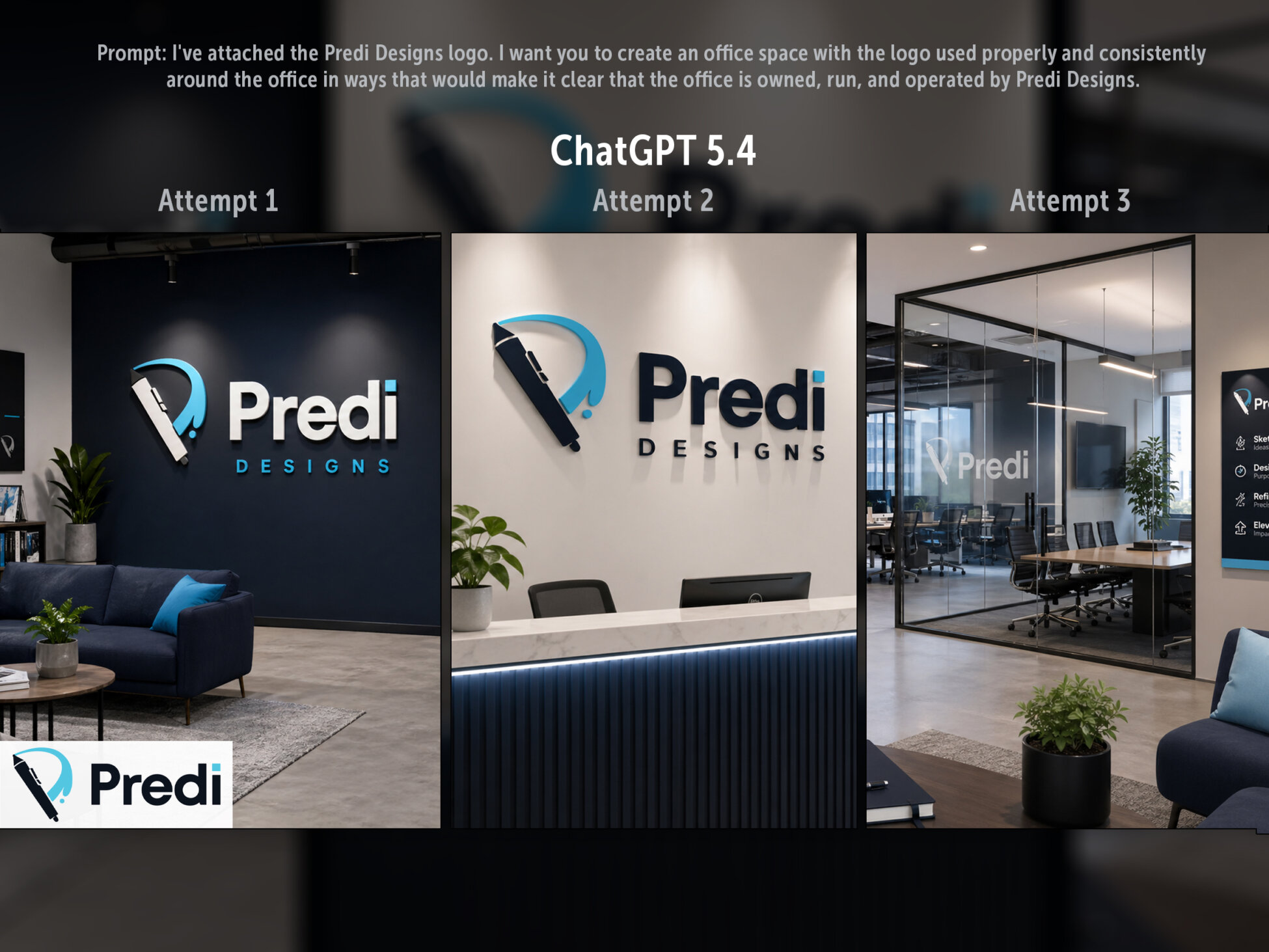
We experimented with doing the exact same prompt over 10 times and each time AI sent back something different, modifying the logo various ways in the process. This inconsistency is why it is impossible to use AI as the final deliverable if brand identity and consistency is a factor.
This is where professional design still matters. A designer knows when something is off, when a font feels wrong, or when product images aren’t scaled proportionally. AI does not carry that responsibility. It generates options irresponsibly. A designer decides what is useful, accurate, brand-appropriate, and worth publishing.
That is Predi’s position. We know how to use these tools, and we use them where they make sense. We are not pretending they do not exist, but we are also not outsourcing your brand’s judgment to them. The final deliverable should still feel considered, intentional, and shaped by someone who understands what the work is supposed to accomplish.
AI is here, and it is useful. Pretending otherwise does not help anyone. Used responsibly, it can speed up tedious tasks, organize rough content, and help early ideas take shape faster.
But Predi Designs is not built around handing your brand over to a machine. Our job is still to think clearly, make judgment calls, build with intention, refine the details, and protect the quality of what gets published. AI can support the process, but it should not replace the people responsible for the final result.
The tool is new. Our standards are not.
Predi Designs uses AI responsibly, like transcribing data from screenshots or scrubbing documents of irregular formatting issues. That kind of tedium would otherwise waste hours of potential design time.
We Walk The Line
Where AI Fits Into Our Workflow
AI is most useful when it takes tedious work off the table. There are plenty of tasks in design that are necessary but not especially creative. Cleaning up messy text, extracting information, organizing rough notes, turning scattered thoughts into something usable. Those are places where AI can save real time without taking over the actual design decision-making.
A good example is data extraction. Several Predi clients work in engineering-related industries, which means a lot of technical documents, specification sheets, and data tables. Sometimes that information exists only inside a PDF or screenshot, and there is no clean way to pull it into a spreadsheet. In the past, that could mean hours of manual typing, checking, and rechecking. Now we can use AI to help convert that table into structured data, then bring it into InDesign where the real design work happens.
Another example is document cleanup. We worked through a large batch of HSE policy documents that needed to follow the same formatting approach. AI was not capable of formatting the final documents correctly by itself. Not even close. What it could do well was strip away the messy parts: inconsistent bullets, strange spacing, random capitalization, odd tabs, and leftover formatting junk. That gave us cleaner text to work with and saved hours of mind-numbing cleanup.
That is where AI makes the most sense to me. It helps remove the parts of the process that slow humans down before the real work begins. It can help get past a blank page. It can help organize rough content. It can make tedious conversion tasks less painful. Used that way, AI creates more room for design instead of pretending to be the designer.
An AI generated image can look fine at first glance, but extremely often these images are filled with errors and artifacts that can't be fixed using the same tool that originally made them.
A Step Too Far
Where We've Reached an Impasse
Predi Designs does not treat AI-generated visuals as finished design work. At no point should one of our designers respond to a client request by simply generating an image with AI and sending it back as the final deliverable. That is not the service clients are paying for. A prompt result is not the same as a carefully built piece of marketing.
That does not mean we refuse to touch AI-generated material. Clients are using these tools, and that has changed what shows up in our inbox. Sometimes a client sends an AI image and asks us to fix the weird parts. Sometimes they ask us to make “something like this.” That can be useful as a rough directional reference, but it is rarely something we can treat as a final asset.
AI can create something that looks polished at first glance, but it often falls apart when inspected. Strange fingers, warped lettering, random artifacts, impossible product details, inconsistent lighting, and visual choices that make no practical sense. These types of errors can’t be fixed using AI once they are generated.
The client may be proud of what they generated, and therefore they ignore its obvious faults. Several have never had the capacity to “create” this effectively before. But speed does not magically turn the result into a professional marketing asset.
When a client sends us AI-generated material, we evaluate it like anything else. Is the idea useful? Is the visual direction worth keeping? Can the mistakes be corrected cleanly? Or would it be smarter to rebuild the concept properly from the ground up? AI has the potential to provide a starting point, but the final needs human judgment, human correction, and human responsibility.
We did several tests to compare Predi's carefully crafted designs with ChatGPT's approach. This one in particular felt most pertinent. Instead of a pig valve, it created a valve in the shape of a pig.
AI Visuals Can Hurt A Brand
The Dangers For Our Clients
The biggest risk with AI visuals is not that they necessarily look bad. It is that they can look impressive to people who do not know what they are looking at, while looking completely wrong to the people who do. A general viewer may see a polished generated image and assume it is professional. Someone with industry experience may see the same image and immediately recognize that the details are incorrect and absurd. For Predi’s clients, especially in industrial, manufacturing, energy, and technical fields, that post can destroy a brand’s credibility.
I have seen AI-generated valve cutaways on LinkedIn that were absolutely ridiculous if you understand those products like I do. For the midstream company who posted the picture, that is not a small problem. The internal structure was complete nonsense, so it made the company look far less knowledgeable about the industry and that damaged their brand with the exact people the post was supposed to reach.
There is also a broader audience problem. AI-generated imagery still carries a stigma with a lot of people. The reaction depends on the industry, the use case, and how transparent the company is being, but backlash is real. A 2025 Clutch article reported that many consumers want brands to disclose AI use, and public controversies around AI art have shown that people do notice when companies appear to replace human creative work without care.
The gaming world has been a useful warning sign. In 2025, Game of the Year winner Clair Obscur: Expedition 33 became part of a public controversy after The Indie Game Awards rescinded awards over generative AI assets that violated its eligibility rules, even though the broader context around the game and its development was more complicated. The lesson for marketing is not “never touch AI.” The lesson is simpler: if your audience cares about craft, accuracy, or trust, AI usage can become a damning part of the brand story whether you intended it or not.
We experimented with doing the exact same prompt over 10 times and each time AI sent back something different, modifying the logo various ways in the process. This inconsistency is why it is impossible to use AI as the final deliverable if brand identity and consistency is a factor.
I've Got Soul
Brands Need A Human Touch
Brand consistency is one of the biggest reasons AI is not a lone wolf answer for companies with a reputation to protect. A brand is not one nice image. It is typography, color, spacing, tone, hierarchy, visual habits, file preparation, audience awareness, and long-term consistency across every piece of communication. AI can imitate a direction, but it does not reliably maintain a brand system on its own.
That becomes obvious when you test it. Give the same visual prompt to an AI tool in five different tabs and you will get five different interpretations. Maybe they all look decent. Maybe they even look impressive. But they will not behave like one unified brand system. They will drift in style, lighting, detail, composition, and personality. That is a problem if you are trying to build recognition over time.
This is where professional design still matters. A designer knows when something is off, when a font feels wrong, or when product images aren’t scaled proportionally. AI does not carry that responsibility. It generates options irresponsibly. A designer decides what is useful, accurate, brand-appropriate, and worth publishing.
That is Predi’s position. We know how to use these tools, and we use them where they make sense. We are not pretending they do not exist, but we are also not outsourcing your brand’s judgment to them. The final deliverable should still feel considered, intentional, and shaped by someone who understands what the work is supposed to accomplish.
AI is here, and it is useful. Pretending otherwise does not help anyone. Used responsibly, it can speed up tedious tasks, organize rough content, and help early ideas take shape faster.
But Predi Designs is not built around handing your brand over to a machine. Our job is still to think clearly, make judgment calls, build with intention, refine the details, and protect the quality of what gets published. AI can support the process, but it should not replace the people responsible for the final result.
The tool is new. Our standards are not.

Matthew A.
Owner of Predi Designs
Matthew began as an online content creator in his teenage years, crafting Flash animations and games for internet audiences and collaborating with other young creatives worldwide. He later graduated cum laude from Texas A&M University’s Visualization Program, where he honed his skills in design, animation, and interactive media. He has owned and operated Predi Designs since 2016.
A Subscription Just Makes Sense.
Predi Designs delivers unlimited high-quality graphic design for a flat monthly rate, making top-tier branding and marketing more affordable, flexible, and efficient than traditional agencies. Plus, without salaries, benefits, or equipment costs, it’s more cost-effective than hiring in-house. No hourly fees, no scope limits. Just fast, reliable design on demand. Scale smarter, save more, and streamline creativity with Predi Designs.
blog tags
related posts
 The early months of the COVID lockdown created stress for nearly every business I worked alongside. Clients were juggling layoffs, unpredictable budgets and constantly shifting priorities, and most of them were trying to keep their teams afloat with limited financial clarity. One client in particular was falling behind on invoices with no clear path to catch up. The sudden silence surrounding payment was unusual. They were still sending work, still pushing for campaigns and content, yet visibly struggling to communicate about finances. I felt undervalued at the time, but I also understood the pressure their internal teams faced. After two months of unpaid work, I made a decision that felt risky but human. I reached out with empathy instead of confrontation, which turned out to shape the next several years of our partnership. It became one of the most defining business lessons of my career, and a reminder that relationships are often more valuable than short term frustration. For anyone building a business rooted in trust, this story might resonate.
 Predi Designs has grown almost entirely through real-world recommendations. The business has thrived because former clients and colleagues continue to speak highly of their experience long after a project ends. Their confidence in our work built a steady flow of new opportunities without paid advertising or heavy online marketing. This article highlights how those offline connections and positive experiences shaped the company’s growth and inspired the testimonial features on the 2025 website.
 One belief has guided how I work for years, long before Predi Designs ever existed. Rarely is a marketing project truly urgent enough to ruin a weekend. Marketing matters, but it is not life or death. If a project cannot survive even the shortest of turnaround times, something upstream has already gone very wrong. Over time, that belief became more than a personal preference. It shaped how I structure client relationships, how I set boundaries, and how Predi Designs operates as a subscription partner. I have seen what happens when teams live in constant emergency mode, and it is not sustainable. It burns out good people and produces rushed work that rarely performs well, and has the potential to hurt the brand with overlooked mistakes and rash decisions. The goal has never been to work less. The goal has always been to work better. That philosophy shows up in every subscription we run.